art autonomy refers to the idea that art can exist independently from external social, political, or economic influences. debates surrounding this idea have lasted centuries, with this concept historically being tied to enlightenment philosophy. Immanuel Kant himself described art as "purposive in itself", which later gave rise to the French slogan "l'art pour l'art" (art for art's sake) (Wilcox, 1953). this notion of autonomy was widely adopted, even appearing as the Latin motto of the Metro-Goldwyn-Mayer film studio.
the autonomy of art is extremely contested, however. for Theodor W. Adorno, autonomy was paradoxical: art only maintains its power when distanced from capitalist ideas, but will always be influenced by them (Markus, 2006). others argue that one should strive to dissolve art's autonomy because then art and life are merged. this tense debate persists until today, where autonomy is viewed both as a space of resistance but also as an illusion masking institutional dependencies.
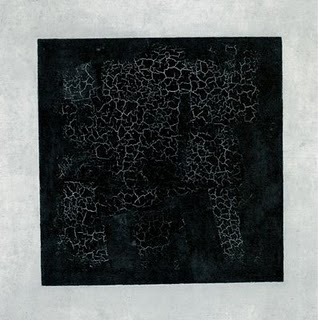
Kazimir Malevich's Black Square (1915) is often hailed as a radically autonomous artwork, literally stripped of representation and purpose. it could also be argued that the decay of the painting is a reflection of the wars and revolutions it lived through, and so has its status of autonomy faded with time, too? Kazimir Malevich's Black Square is often considered to be a radically autonomous artwork. it literally strips itself of any representation or purpose, which distances itself from any political ideologies under which it exists. however, the artwork was banned in the USSR and was hidden away and archived in the Soviet archives which heavily influenced its condition. and so its cracks and damage tell a story of the political influences the painting lived through. could it be argued that how an artwork is understood and interpreted by its audience has an influence on its autonomy? what about how it is handled in the society it lives in? ultimately art, particularly physical art, will have a story of how it came to be and it is impossible for that not to be influenced by the context of the world around it. and so can any art really be autonomous? what is the goal? autonomous or not?
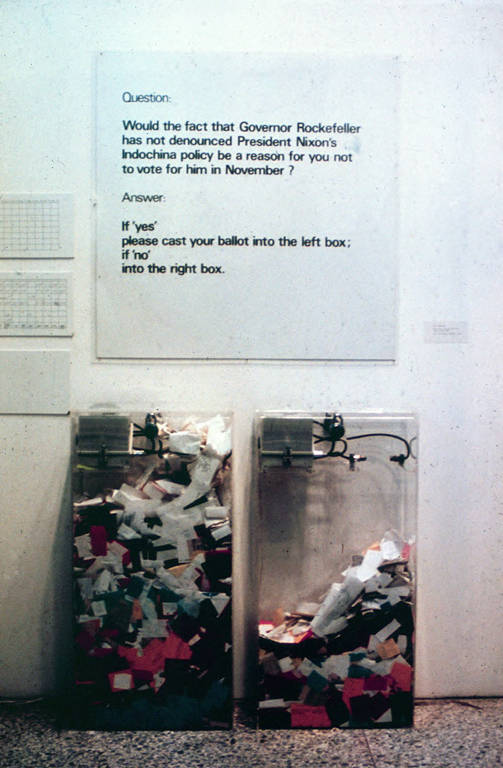
alternatively, Hans Haacke's MoMa Poll (1970) directly tackles an ongoing political issue by artistically demonstrating the influence of social and political influences. here, the approach is so different to the Black Square by directly embedding itself in the political battlefield of the current times. however, i would almost argue that the Black Square tells just as much of a story. MoMa Poll tells a story of its observers to its observers by playing with the notion of political polling. whereas Black Square tells the story of an oppressive regime through the life the painting itself has endured. so really the meaning of the artwork does not come from the physical realisation but rather this idea that is contextualised by the observer.
“Autonomy relied on a certain distribution of power and sense to be effective and global neoliberalism has simply circumvented art’s disruptive role by incorporating it into its patterns of consumption. All the autonomy in the world, while necessary is no longer sufficient; it will not challenge the place of art as a luxury product, as a sign of sophisticated oligarchy, or as a way of proving neoliberalism’s toleration of all expression that stems from a subjective individual position. Ultimately, I don’t think you can liberate yourself. Humans exist in society. Everything they do is entangled not only with other humans but all other lifeforms, objects, and phenomena. Any one individual self is largely a product of this entanglement and how that individual chooses to negotiate with it for him/herself.” - Charles Esche's introduction for self-empowerment in Truth is Concrete
adrian robinson
last updated: december 2025